


Case Study: How Market Research Helped Jackson Expand to Helena
Dana Pulis Owner and Principal
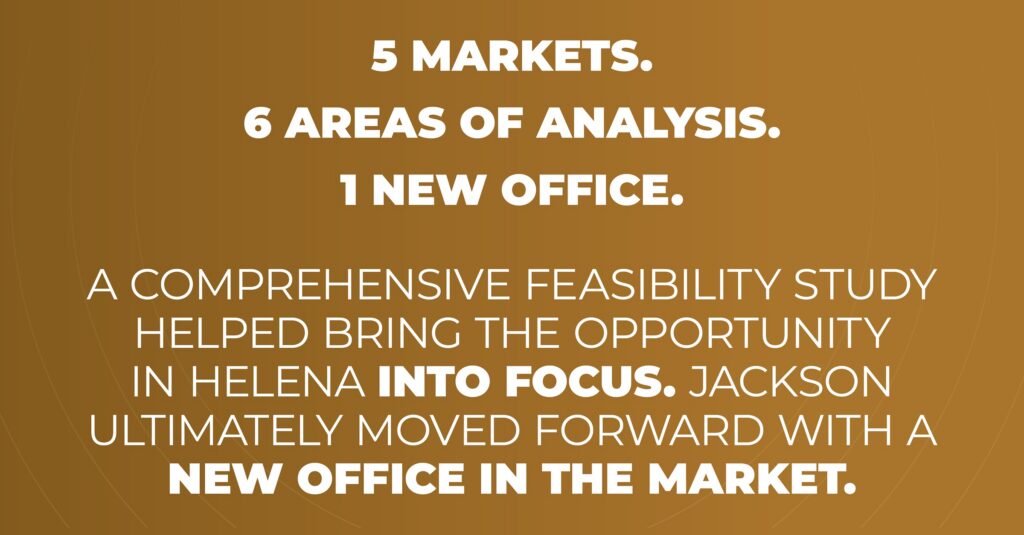
A comprehensive feasibility study helped bring the opportunity in Helena into focus. Jackson ultimately moved forward with a new office in the market.
How can a market feasibility study reduce the risk of business expansion?
A market feasibility study reduces expansion risk by comparing demand, competition, workforce, costs and growth conditions before an organization commits capital. For Jackson Contractor Group, Kinetic Marketing & Creative evaluated five Montana markets and developed actionable recommendations that supported the successful opening of a new office in Helena.
A feasibility study is a preliminary, evidence-based assessment designed to answer two fundamental questions: Can we do this? And should we do this?
Unlike a business plan, which maps out how an organization will execute a decision, a feasibility study evaluates whether an opportunity is practical and viable in the first place. It is not a commitment to move forward, a guarantee of revenue or margin or a site-selection plan. Those steps come later if leadership decides an opportunity is worth pursuing.
The Opportunity
Jackson Contractor Group was preparing for its next stage of growth. After restructuring its organization to support a larger volume of work, the company needed to determine which Montana markets offered the strongest opportunities for sustainable and profitable expansion.
Leadership had identified Billings, Kalispell, Helena, Lewistown and Polson as potential markets. Each offered a different mix of construction activity, public investment, workforce conditions, operating costs and competitive pressure. Choosing a location based on momentum or familiarity alone could expose Jackson to unnecessary risk. The company needed a clearer view of where demand was strongest, where its capabilities fit best and what conditions would need to be in place before entering a market.
Kinetic was engaged to turn a complex expansion question into a practical path forward.
The Approach: Start With the Decision, Not the Data
Before researching markets, Kinetic needed to understand what a successful expansion actually looked like for Jackson.
The work began with a four-hour, in-person strategic workshop with Jackson leadership. The session aligned the team around growth goals, current assumptions, organizational strengths and the criteria that should guide the market evaluation.
Both teams established four priorities that became the lens for the entire study: validate demand, maintain a stable public-sector backbone, solve workforce challenges early and strengthen digital visibility.
From there, Kinetic evaluated five Montana markets against those priorities using the most current public information available at the time of the study. The findings were intended as directional guidance based on current conditions, not a prediction of future market outcomes.
Looking Beyond the Obvious Numbers
Kinetic then completed a comprehensive market and competitor feasibility study across all five proposed locations. The analysis examined:
- Demographic and economic conditions: Population trends, income, economic stability, industry growth and local development priorities.
- Construction activity and forecasts: Market pace, major project types, long-range development and the balance of public and private opportunities.
- Public-sector investment: Capital improvement plans, school bonds, infrastructure programs and other sources of predictable construction demand.
- Workforce and talent: Labor availability, salary expectations, recruitment considerations and each market’s ability to support key operational roles.
- Competitor presence and positioning: Established contractors, relevant market strengths, service alignment and the intensity of competition.
- Digital visibility and market alignment: Competitor websites, search presence, social activity and opportunities for Jackson to establish credibility in each location.
The value came from understanding how those factors worked together — not simply evaluating them as individual data points.
From Research to Recommendation
The goal wasn’t to produce more data. It was to make the data useful.
The final study did not recommend entering every market at once. It organized the opportunities into a staged expansion strategy based on market role, timing and risk.
Kinetic also provided practical decision gates and performance indicators Jackson could use as it moved forward. These included qualified pipeline, anchor-client relationships, strategic partnerships, named leadership and operations talent, financial thresholds and market-specific visibility measures.
The result was not simply a ranking of cities. It was a decision-making framework that showed Jackson where opportunity existed now, where it made sense to wait and what conditions should trigger future investment.
Helena emerged as a compelling near-term opportunity. Its stable, government-driven economy, consistent public-sector investment, favorable workforce conditions and relatively open digital landscape aligned well with Jackson’s strengths and growth priorities.

The Research Became Reality
Jackson Contractor Group successfully opened its Helena office, strengthening its presence in central Montana and positioning the company to pursue long-term opportunities in the region.
The research also created a natural bridge from strategy to activation, with Kinetic launching a targeted Google Performance Max campaign to introduce Jackson’s new Helena office, build local awareness and support the company as it established a stronger presence in the market.
The expansion reflects exactly what a feasibility study is designed to do: replace avoidable assumptions with evidence, clarify the opportunities and risks and give leadership a stronger foundation for making a consequential investment.
Feasibility Studies for High-Stakes Decisions
Feasibility research can support decisions well beyond market expansion. Kinetic designs in-depth studies to evaluate whether an opportunity is practical, sustainable and aligned with an organization’s goals before major resources are committed.
Our feasibility capabilities include:
- Market feasibility studies: Evaluate demand, customer needs, competitive conditions, workforce, operating costs, market entry options and growth potential.
- Technology feasibility studies: Assess whether a proposed platform, system or digital solution can meet operational and user needs within available technical, staffing and implementation constraints.
- Economic feasibility studies: Examine costs, funding conditions, economic impact, financial sustainability, risk factors and the assumptions that affect long-term viability.
Every study starts with the decision an organization needs to make. We combine strategic discovery, credible research and competitive analysis — plus primary research when appropriate — to deliver clear recommendations, risks and next steps.
Considering a new market, technology or major investment? Contact Kinetic Marketing & Creative to learn how a customized feasibility study can help you evaluate the opportunity.
Dana Pulis
Owner and Principal
Since launching Kinetic in 2007 from her heart and the living room of her Billings home, Dana Pulis has focused on moving businesses forward through creative marketing communications. Her intense focus has produced amazing results for a long list of local, regional and national clients. That focus has dramatically grown Kinetic from a local firm to a national agency that has won awards against some of the largest ad agencies in the country.
Dana is a nationally-known marketing expert. She’s an award-winning writer, accomplished public speaker and respected business leader. She recruits top pros – account directors and project managers looking for the next challenge, and designers and writers looking to push their creative boundaries.
Read more about Dana