

What UNBOUND 2026 Taught Us About Continuous Campaigns
From the desk of Kinetic’s Digital Director
The marketing funnel didn’t break. It turned into a loop, and the brands that win now are the ones that keep it running.
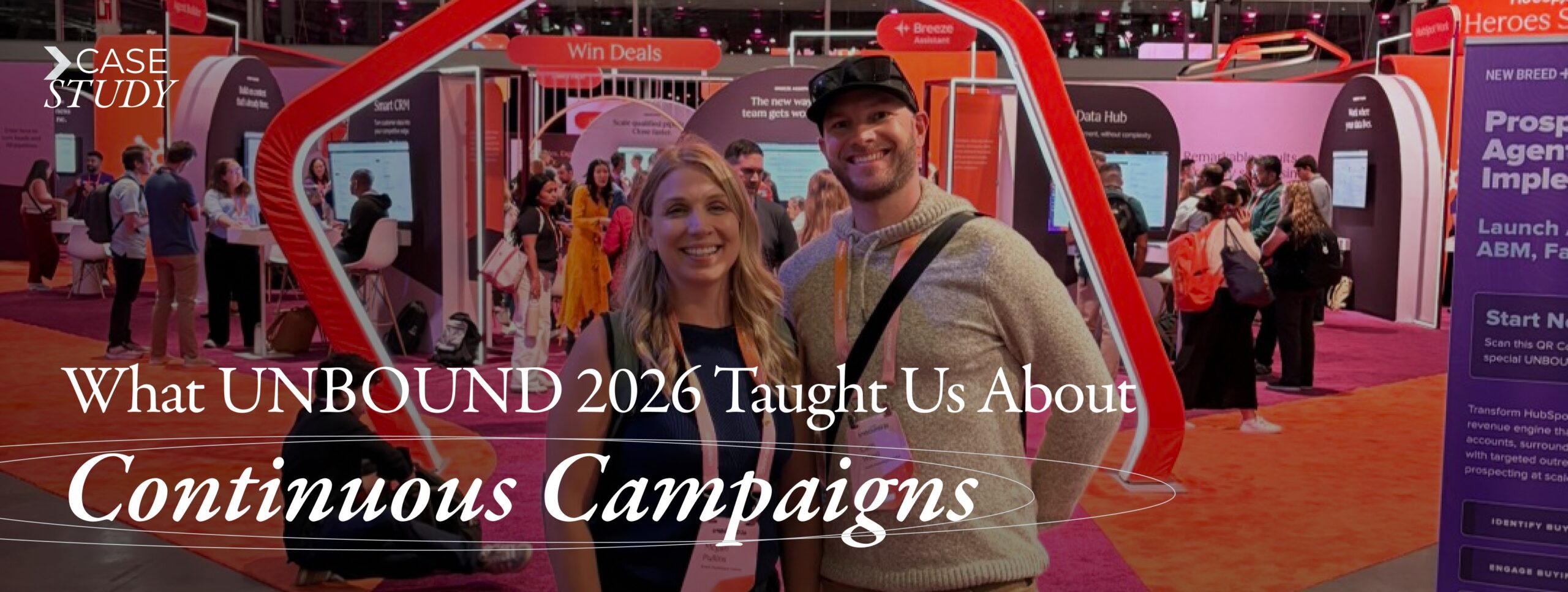
In September, our team spent four days at HubSpot’s UNBOUND 2026, including Partner Day, in Boston. We came home with tons of fresh ideas from thought leaders across the industry. Speakers came from education and nonprofits, healthcare, manufacturing & industrial, beauty and wellness, software, retail, finance and media. Their industries were different. Their story was the same: the buyer journey we were all trained on no longer describes how people actually buy.
HubSpot was candid about its own experience. In the Running Loops session, Steph Crigler shared that HubSpot’s own website traffic fell 80% over ten months. If the company that wrote the inbound playbook felt it, everyone did.

Slide: “Running Loops: A Marketer’s Guide to AI-Era Growth,” HubSpot UNBOUND 2026. Figures as presented by the speakers, with their cited sources.
What changed: buyers moved before we did
The classic funnel assumed we controlled the path: awareness on our ads, consideration on our website, conversion on our forms. That path has scattered. Buyers now form opinions in answer engines, social feeds, Reddit threads, review sites and YouTube before they ever reach a brand’s site. Across speakers, we saw a recurring theme: our classic marketing funnel turning into an hourglass.
It goes like this: awareness is cheaper and more spread out, the middle is being reshaped by AI and the people who do arrive come with much higher intent.

Slide: “Build Your Loop Foundation: ICPs and Segmentation,” HubSpot Academy Labs, UNBOUND 2026.
The second shift is how answer engines decide what to say about you. They don’t take your word for it. They build an answer from consensus across many sources. In HubSpot’s citation data, shown in the Running Loops session, a brand’s own website made up about 8% of AI citations. Earned media and peer sites carried far more weight. If your message changes from channel to channel, the consensus about you gets weaker.

Slide: “Running Loops,” HubSpot UNBOUND 2026. Source as cited on the slide: HubSpot.
HubSpot’s answer is Loop Marketing: four stages that repeat instead of a campaign that ends.
- Express your point of view.
- Tailor it to audiences and channels.
- Amplify it across owned and third-party surfaces.
- Evolve by feeding what you learn into the next cycle.
Each loop should make the next one smarter.

Slide: “Running Loops,” HubSpot UNBOUND 2026.
Context is the new conversion lever
Good context makes better conversion. Bad context is worse than no context.
That line became our team’s shorthand for the whole conference. Session after session landed on the same point: AI and answer engines don’t invent your story. They repeat whatever context you give them, at scale.
HubSpot’s VP of Product, Sophie Higgs, framed it this way in her Smart CRM keynote: data records what happened, while context explains why it happened and what to do next. HubSpot Academy put it even more plainly on a single slide: “AI scales what it knows. Generic input means generic output.”

Slide: “Build Your Loop Foundation: ICPs and Segmentation,” HubSpot Academy Labs, UNBOUND 2026.
So why is bad context worse than none at all? Because AI doesn’t hesitate. With no context, you get something bland that a person will probably catch and fix. With the wrong context (an outdated ideal customer profile (ICP), positioning that sales and marketing describe differently, a value proposition that changes by channel), you get confident, polished output pointed in the wrong direction. GrowthX CEO Marcel Santilli summed it up in his AEO session: fragmented context makes you faster at making the wrong thing. And because answer engines build their view of you by consensus, inconsistent messaging doesn’t just waste one campaign. It weakens how AI describes your brand everywhere.
The work Kinetic was built on is now the input AI runs on
Here’s what struck me most in Boston. The foundation every speaker said you need before a loop can work is the same foundation Kinetic Marketing & Creative was built on: brand messaging, positioning, ideal customer profile development, personas and product positioning. These were never “nice to have” strategy documents. They are now the context that tells AI, answer engines and every channel who you are and who you serve.
| Foundation | The question it answers | Where it powers the loop |
| Brand messaging | What do we say, and how do we sound saying it? | Express: one consistent voice across every channel |
| Positioning | What category are we in, and why are we different? | Express and Amplify: the consensus answer engines repeat |
| Ideal Customer Profile | Which organizations are the best fit? | Tailor: who to focus on and who to leave out |
| Personas | How do we talk to the people inside them? | Tailor: the message, pain point and proof for each role |
| Product positioning | Which offering solves which problem, for whom? | Amplify and Evolve: pages and content answer engines can cite |
HubSpot Academy’s lab showed how these pieces fit together. Your ICP tells you which companies to focus on. Personas tell you how to talk to the people at those companies. Segments tell you who in your database is ready for a specific message today. Underneath all of it sits your structured and unstructured data.

Slide: “Build Your Loop Foundation: ICPs and Segmentation,” HubSpot Academy Labs, UNBOUND 2026.
Where to start: the context sections AI reads first
HubSpot gave a practical map of what to document first. In his admin implementation session, HubSpot Academy’s Kyle Jepson recommended filling in the Agent Hub context page before anything else, even if you have no agents planned yet. Sophie Higgs described the same layer as Growth Context: the business details that keep AI output from feeling generic. Pulling those sessions together, here is the order we prioritize, and the Kinetic foundation that feeds each one.
| Priority | Context section | What to document | Kinetic foundation behind it |
| 1 | Business | Company description, business model, industry | Positioning |
| 2 | Customers | Ideal customer profiles, personas, segments | ICP development, personas |
| 3 | Products | What you sell, value propositions, who each offering is for | Product positioning |
| 4 | Competitors | Who you compete with and how you differ | Positioning |
| 5 | Brand | Voice, brand kit, the story you tell | Brand messaging |
| 6 | Sales process and operating instructions | Stages, handoffs, rules AI should follow | Process mapping |
Jocelyn Horn’s session on AI-ready CRM data reinforced the point. Of three configuration moves that turn HubSpot’s AI from generic to useful, the first was Context Home: company description, products, personas and competitors. She also recommended auditing that context every quarter, because an ICP or positioning statement that goes stale quietly turns good context into bad context.

Slide: “Get Your Data AI-Ready: Configure a CRM That AI Can Use,” Jocelyn Horn, HubSpot UNBOUND 2026.
Going deeper: the Taste Profile
The context sections tell AI what is true about your business. They don’t tell it what your audience will actually respond to, or what your brand sounds like at its best. For that layer, we’re borrowing the Taste Profile from Kipp Bodnar and Kieran Flanagan’s Loop Marketing book. It has two parts, and both map directly to the persona and messaging work we already do with clients.
Part 1: Customer taste. What your audience responds to.
| Element | What it captures |
| Emotional register | The feeling your audience responds to, such as reassurance, urgency or ambition |
| Language | The words and phrases customers use to describe their own problems |
| Content triggers | The topics, formats and moments that make them stop and engage |
| Anti-triggers | What makes them tune out, roll their eyes or stop trusting you |
| Situational framing | The circumstances they’re in when they meet your message |
| Trusted voices | The people, publications and peers they already listen to |
Part 2: Brand taste. The stories only your brand can tell.
| Story | What it captures |
| Brand story | Why you exist and what you believe |
| Product story | What you make and the problem it solves |
| Thought leadership story | The point of view you own in your category |
| Customer story | The proof, told through your customers’ outcomes |
Together, the context sections and the Taste Profile give AI, answer engines and your own team the same clear picture of who you serve and how to talk to them. That’s what good context looks like. It’s also exactly what keeps a loop from drifting into generic content as it scales.
How we build continuous campaigns on the loop
A continuous campaign isn’t an always-on ad. It’s a system where each cycle starts with better context than the last. Here’s how we’re putting the loop to work for our clients.
- Express: lock the foundation first. Before anything ships, we document brand messaging, positioning, ICPs, personas and product positioning in one source of truth. In HubSpot, that context can live centrally so AI tools draw from it instead of guessing. Then we review it every quarter for new offerings, competitors and shifts in who’s buying.
- Tailor: build one strong core asset, then adapt it. We start from the questions real buyers ask (in sales calls, support tickets, search data and AI prompts) and create one anchor piece. From there we adapt it by segment using three signals HubSpot Academy called out: fit (who they are), intent (what they’re doing) and stage (where they are in their journey).
- Amplify: show up where the consensus forms. Owned channels still matter, but answer engines lean on earned media, peer sites, reviews and video. We take the same core message to those places, consistently, so the consensus about our clients is clear and accurate.
- Evolve: measure what feeds the next loop. Remington Begg of Impulse Creative mapped each loop stage to a metric. We like his “four Rs” because they ask better questions than channel dashboards alone.

Slide: “Running Loops,” HubSpot UNBOUND 2026.
Two habits make this work. First, set one time-bound goal tied to pipeline or revenue before a campaign launches, so every loop is judged against the same finish line. Second, treat every result as new context. The segment that converted, the question that earned a citation, the phrase a customer used on a sales call: all of it goes back into the foundation and makes the next loop stronger.
There’s so much more we learned. Here are a few fun ones.
We could write a dozen posts from what we brought home, and we probably will. But the biggest surprise wasn’t a statistic. HubSpot is a surprisingly welcoming and joyful place. The gravity of the show was impressive, the execution was outstanding and the value packed into three days was significant. Most of all, you could feel the grit it is taking to explore, test and find new ways to lead through this pace of change.
No one captured that grit better than Tom Brady. He laughed through the scouting report that dropped him to pick 199 in the 2000 draft (“poor build, skinny, lacks mobility”) and admitted it was all true. He started as the seventh quarterback on Michigan’s depth chart and the fourth with the Patriots. His edge was never physical. It was treating every practice like the Super Bowl, with a list of small things to improve written on his wristband each day.
Asked how a room full of marketers should keep going once they got home and started becoming builders with AI, he said:
“When you start, you’re not going to be as good at it the first time as you will be the 1,000th time, but the only way you can get to 1,000 is by starting at one.”
That is the loop in one sentence. He also shared a story about a Hall of Famer explaining success to a young fan: good decisions come from experience, and experience comes from bad decisions. Every loop gives you a little more experience.

A few fun facts we can’t stop talking about:
- Emails are full copy with bullets again (exciting!). Jay Schwedelson showed that AI assistants in Gmail, Apple Mail and Copilot now summarize emails before people read them. Live text and bullet points get pulled into those summaries. Copy baked into an image doesn’t.
- One email template is not enough. People get bored. Rotating layouts and formats keeps your audience opening.
- Email lists depreciate. Contacts change jobs, inboxes go quiet and data goes stale. Ongoing cleanup is a must, not a once-a-year project. HubSpot’s Jocelyn Horn recommended a monthly dedupe review to stay ahead of it.
And if all this change ever leaves you frozen, Mel Robbins will pick you up. Count down from five, 5, 4, 3, 2, 1, and move. She also left us with a line that reframed why any of this matters:
“Purpose is not the thing that you do. Purpose is the thing that happens in other people when you do what you do.” (Mel Robbins)
For a marketing team, that may be the truest measure of a loop. It isn’t the content we ship. It’s what changes for the customers on the other side of it, and what we learn to do better next time.
Want to build a loop that compounds? Kinetic Marketing & Creative helps brands put the right foundation in place (brand messaging, positioning, ICPs, personas and product positioning) and turn it into continuous campaigns that get smarter every cycle. Let’s talk about what your next loop could look like.
Sessions referenced
All sessions from HubSpot UNBOUND 2026, Boston, September 16 to 18, 2026. Statistics are reported as presented by the speakers.
- Main stage keynotes: Tom Brady and Mel Robbins
- Running Loops: A Marketer’s Guide to AI-Era Growth: Steph Crigler (HubSpot), Christine Lee (HubSpot Academy), Remington Begg (Impulse Creative)
- Build Your Loop Foundation: ICPs and Segmentation: Christine Lee and Clare Wetmore (HubSpot Academy)
- How Smart CRM Powers the Agentic Customer Platform: Sophie Higgs (HubSpot)
- Implementation: Things Every HubSpot Admin Needs to Know: Kyle Jepson (HubSpot Academy)
- Get Your Data AI-Ready: Configure a CRM That AI Can Use: Jocelyn Horn (HubSpot)
- What 10,000 Hours of AEO Taught Us: Marcel Santilli (GrowthX)
- Do This, Not That: Fastest Lifts in Content, Offers & AI: Jay Schwedelson (Guru Media Hub)
The Taste Profile framework is from Loop Marketing by Kipp Bodnar and Kieran Flanagan.